Hunger is on the Ballot this Fall
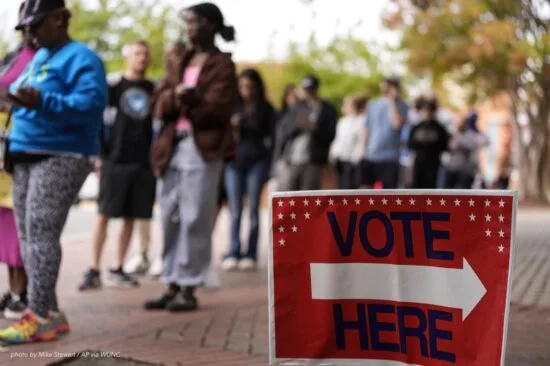
So many of the drivers of hunger are addressed — or not — through public policy.
Government funding for food purchases and distribution is set through the state budget process. Members of Congress determine who is eligible for SNAP (often called FNS or ‘food stamps’) and how much support families receive for groceries. Local elected officials directly influence whether school meals, backpack programs, and other supports will be available to kids in our communities.
Whether at the polls or in government buildings across the state, hunger is always on the ballot in some way.
It's more important than ever to make our voices heard.
Broad, Bipartisan Support
From funding for food purchases from local farmers, to disaster relief aid, to eligibility for SNAP, WIC, and senior meals, many decisions that directly impact people facing hunger are made at the State Capitol, in the halls of Congress, and even at the ballot box.
Hunger and poverty touch all of our lives in some way, regardless of party affiliation or political ideology. At the Food Bank, We work hard to bring decision-makers together to focus on eliminating hunger and its root causes in our communities. And we’re proud to have the support of leaders across the political spectrum who believe in our vision for a hunger-free future — because it will take all of us working together to achieve it.
Collective Action for Change
Close to 630,000 people face hunger today across central and eastern North Carolina. Our Food Bank Network provides more than 90 million meals each year to help meet emergency needs. Yet even at our scale, we know we can’t provide enough food for everyone facing food insecurity. We have to do more to prevent hunger and poverty from happening in the first place.
That’s why thousands of Food Bank supporters are joining together to advocate for the policies and investments we need to meet today’s challenges head-on and end hunger for good. Because the decisions we make in the coming weeks will directly impact our collective ability to stop hunger at its roots.
Learn More About Hunger in Your Area
To advocate for real solutions, it's important to first understand the scope and scale of the challenges our communities face. Explore hunger and impact statistics by region and county. Select a county from the map or dropdown menu, or choose a region:
All Counties
Help us improve your experience by sending an error report to communication@foodbankcenc.org.
- 629,980Individuals Facing Hunger
- 15% 1 in 7Food Insecure Individuals
- 105 millionPounds of Food Distributed by the Food Bank network
- 86 millionMeals Provided by the Food Bank network
- 447,085People Enrolled for Assistance with SNAP (FNS or Food Stamps)
- $132MLocal Economic Impact of SNAP (FNS or Food Stamps)
[Coming Soon] Who's Who in Government?
Once you understand the scope of the challenge, it's time to get to know the people and roles that drive hunger policy across federal, state, and local government.
Take Action at the Ballot Box
Important Dates & Deadlines
- Friday, September 4, 2026
Absentee Ballots Mailed as Requested - Friday, October 9, 2026
Regular Voter Registration Deadline (arrive by 5 PM) - Thursday, October 15, 2026
First Day of Early Voting - Tuesday, October 20, 2026
Absentee Ballot Request Deadline (arrive by 5 PM) - Saturday, October 31, 2026
Last Day of Early Voting (ends at 3 PM) - Tuesday, November 3, 2026
Primary Election Day (6:30 AM - 7:30 PM) - Tuesday, November 3, 2026
Absentee Ballot Return Deadline (arrive by 7:30 PM)
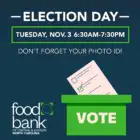
Photo ID Requirements
For some of us, this will be the first election that photo identification is required to vote in North Carolina (the address on your ID does not need to match your voter registration).
IDs that qualify as long as they’re current or have been unexpired for one year or less:
- NC Driver’s License
- NC Non-Driver’s ID
- Driver’s license or non-driver ID from another state (for voters registered in NC within 90 days of the election)
- US Passport or Passport Card
- NC voter photo ID issued by a county board of elections
- Approved college or university student ID
- Approved state or local government or charter school employee ID
IDs that qualify even if they’re expired or don’t have an expiration date:
- Military or veterans ID card issued by the US government
- Tribal enrollment card issued by a tribe recognized by the state or federal government
- ID card issued by an agency of the US government or State of NC for a public assistance program.
- If you’re 65 years or older, any of the above forms of IDs is accepted as long as it was current on your 65th birthday
If you don’t have an acceptable ID when you vote, you can ask for a Photo ID Exception Form. There are also options to obtain a photo ID for free. For nonpartisan assistance obtaining an ID to vote, call 866-ID-2-VOTE (866-432-8683).
Ways to Vote in North Carolina
-
Vote early in person
Any eligible voter can vote early in North Carolina. In-person early voting starts about three weeks prior to each election and ends the Saturday before Election Day (November 2 this year). Each county hosts several early voting sites — though hours and locations vary by county.
Voting early helps to avoid longer lines on Election Day. And with many voting sites open on weekends and outside of normal business hours, we can choose the most convenient time to vote. It’s also a chance to register and vote right away or update a registration, which isn’t an option on Election Day.
-
Vote early by mail.
Any eligible voter can vote by mail (sometimes called an “Absentee ballot”) in North Carolina. You don’t need to be out of town on Election Day or have a special excuse. Many people choose this as a convenient way to vote on our own schedules.
Mail-in ballots must be requested by 5:00PM on the Tuesday before Election Day (October 27 this year) — and all ballots must be received by the County Board of Elections by 7:30PM on Election Day. Unfortunately, a postmark date no longer counts.
-
Vote in-person on Election Day
Any eligible voter can vote on Election Day in North Carolina. This year, Election Day is Tuesday, November 3 — and polling locations are open from 6:30AM to 7:30PM (anyone in line by 7:30PM can vote!).
Unlike early voting locations, each of us must vote at our assigned polling place on Election Day. Most polling places are located within a short distance of home.
Want to see who currently represents you and your neighborhood?
Find non-partisan facts at NCvoter.org.
Trouble Voting?
Call for help anytime: 1-888-OUR-VOTE (1-888-687-8683)
During Early Voting and on Election Day
- Spanish/English: 1-888-VE-Y-VOTA (888-839-8682)
- Arabic/English: 1-844-YallaUS (844-925-5287)
- Asian Languages/English: 1-888-API-VOTE (888-274-8683)
(Available languages include Chinese, Korean, Vietnamese, Bengali, Urdu/Hindi, and Tagalog)
Stay connected to the Food Bank
Sign-up to receive emails with updates, resources, and ways to get involved.